
I have been thinking quite a lot recently about sponsorship, particularly after organising ELEVATE at Benham Park in September. Having spent more than 30 years organising events, fundraising and bringing businesses and people together, I know just how important sponsorship can be, but I also know how incredibly difficult it can be to secure. There is so much more to sponsorship than sending a proposal, asking for money and putting a company’s logo on a screen. It takes research, conversations, introductions, follow-ups and sometimes an enormous amount of patience. You can spend weeks talking to a potential sponsor, feel that everything is moving in the right direction and then discover that the budget has already been allocated, the timing isn’t right or the proposal needs to go through several departments before anyone can make a decision. I think anyone who has ever tried to secure sponsorship will recognise that feeling!
Yet I genuinely believe that when you find the right partnership, the benefits can be extraordinary for both sides. I have been looking at some of the research around sponsorship, including articles in the Financial Times, and what struck me is that sponsorship is no longer simply about brand visibility. Businesses increasingly want to understand exactly what they are getting in return.
According to the World Federation of Advertisers’ 2025 Global Sponsorships and Partnerships study, conducted with Lumency, brands in its sample allocated an average of 11% of their marketing budgets to sponsorship and activation. That is a significant investment, particularly when marketing budgets are under so much pressure. What I found even more interesting was that nearly three-quarters of sponsorship professionals surveyed identified measuring and demonstrating return on investment as a major challenge.
I can understand why. How do you measure the value of someone discovering your brand for the first time? What about a conversation that leads to a business introduction six months later, or someone who sees your product at an event, follows you on Instagram and eventually becomes a customer? These things matter, but they are not always easy to put into a spreadsheet. Of course, sponsors need measurable results, and quite rightly so, but I think we also need to recognise that some of the most valuable outcomes develop over time.
I was particularly interested in a Financial Times article about Samsung’s involvement in the Paris Olympics. The company distributed 17,000 special-edition phones to athletes and officials, creating opportunities for its products to appear naturally in photographs and social media content. According to the article, Samsung reported a 23% increase in sales during the Games. That does not mean the sponsorship alone caused the increase, but it is a fascinating example of how a brand can turn an event partnership into something much bigger than traditional advertising.
What interested me was the thinking behind it. Samsung wasn’t simply paying to have its name associated with the Olympics. It was creating an experience that encouraged people to engage with the product and share it. That is something I think we can all learn from, whether we are working with a global company or a much smaller business.
Another Financial Times article explored the relationship between luxury brands and golf, particularly the long-standing association between Rolex and the sport. The interesting point was that these partnerships are not necessarily designed to generate an immediate sale. They are also about reputation, consistency, reaching the right audience and building long-term brand value. It made me think about how differently we sometimes approach sponsorship when organising smaller events. We can become so focused on securing the funding that we forget to ask what the sponsor is actually hoping to achieve.
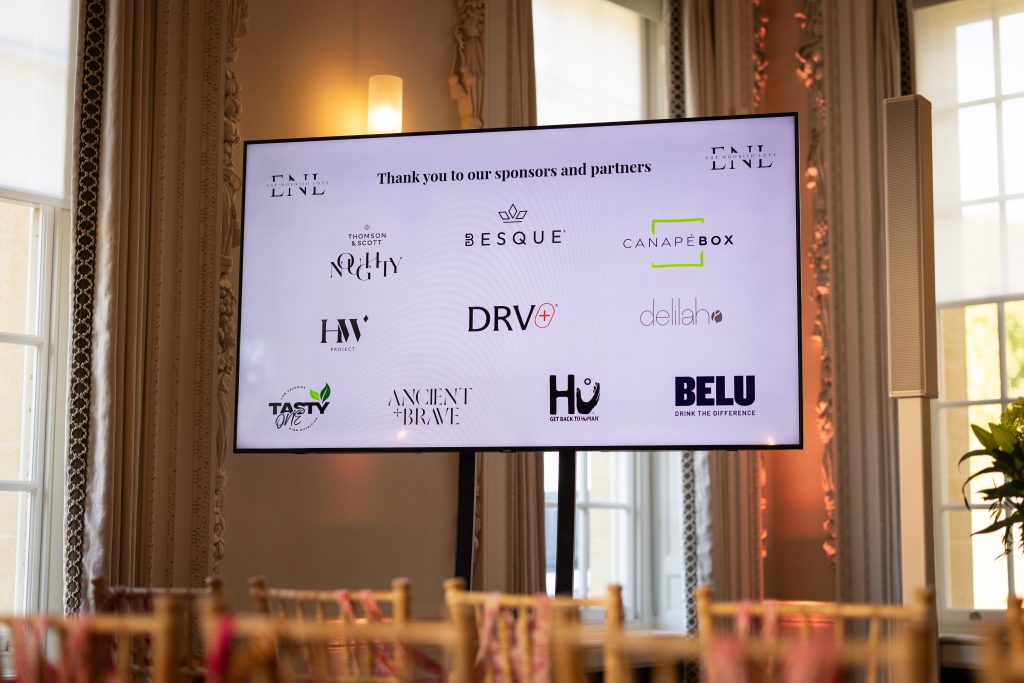
At ELEVATE at Benham Park, we were fortunate to have the support of some wonderful sponsors and partners, including BESQUE, NOUGHTY, CanapéBox, HumanWare Media, Belu Water and DRV+, alongside other brands who helped bring the event together. Looking at the photograph of our sponsors and partners on the screen at Benham Park, I feel enormously grateful. Every one of those relationships contributed something to the event, whether through financial support, products, services, expertise or helping us create the experience we wanted for our guests.
What I have learnt, however, is that the most successful partnerships are those where both sides really understand what they want to achieve. A drinks brand might want people to experience its products, a wellness business may want to introduce itself to a new audience, while another company might be interested in meeting potential customers, developing relationships or becoming associated with particular speakers and conversations. Those objectives are all quite different, so surely the sponsorship opportunities should reflect that?
I think this is where we, as event organisers, have to become much better at listening. Rather than immediately presenting a sponsorship package, perhaps the first question should be, “What are you hoping to achieve, and how could we help you do that?” It sounds so simple, but it can completely change the conversation.
One thing I have become increasingly aware of is how important it is to understand your audience before approaching a potential sponsor. It isn’t necessarily about having thousands of followers or hundreds of guests. It is about knowing who those people are, why they attend, what interests them and whether they are the right audience for the brand you are approaching.
Research from IDC, published in October 2025, found that 67% of the senior marketers surveyed identified brand awareness as a leading priority, while 53% were focused on generating qualified leads. The research also found that more than 90% believed events delivered their greatest value in the middle and later stages of the customer journey, when people are considering options or moving closer to making decisions.
That is particularly interesting because it reinforces something I have believed for years. Events offer an opportunity for genuine engagement that can be difficult to replicate through advertising alone. Someone can see a product, ask questions, hear the story behind a business and develop a relationship with the people involved. But none of that happens automatically. You need to think carefully about who you are bringing together and what you are creating for them.
I think one of the biggest lessons I have learnt is that a logo is not a return on investment. Of course, sponsors should be recognised. Their logos should appear where agreed, their contribution should be acknowledged and they should feel valued, but putting a logo on a screen is not, on its own, a meaningful sponsorship strategy.
The World Federation of Advertisers’ research found that 84% of surveyed brand owners measured sponsorship through brand awareness, while 65% looked at brand consideration. Those are important measures, but I think we should also be asking what happens after the event. Did people engage with the sponsor? Did they visit the website? Were there useful introductions? Did the sponsor receive enquiries? Was there social media engagement? Did the partnership create content that could continue to be shared?
If a company invests £2,500 in an event, it is reasonable for them to want to know what that investment achieved. For example, if a sponsor invests £2,500 and can attribute £5,000 in additional gross profit to the partnership, that represents a 100% financial return on investment, before accounting for any additional activation costs. The important distinction is that sales revenue is not the same as profit, and brand exposure is not the same as a measurable financial return. Not every sponsorship will generate immediate sales, but there should always be a clear understanding of what success looks like. I think the responsibility sits with both the sponsor and the organiser to agree those expectations before the event, rather than trying to work them out afterwards.
This is also why I feel so strongly that the work doesn’t finish when the event ends. After months of planning, organising and delivering an event, it is very tempting to feel that the hard work is finished once everyone has gone home. In reality, some of the most important work is still to come. The photographs, videos, social media posts, introductions and follow-up conversations all create opportunities to extend the life of a sponsorship.
At ELEVATE, we invested in professional photography and video content because I wanted the conversations, speakers and brands to continue reaching people long after the event itself. I think this is an area where smaller businesses and event organisers can be particularly creative. A thoughtful post featuring a sponsor, a short video demonstrating a product or a follow-up introduction can sometimes be more meaningful than simply displaying a logo to an audience.
It is also important to go back to sponsors afterwards, thank them properly and explain what happened. Share the attendance figures, photographs, content, engagement and any other relevant results. Ask what worked for them and what could be improved. That conversation may be the beginning of a much longer relationship.
Another interesting Financial Times article examined the challenges surrounding corporate sponsorship of arts and literary festivals, including the difficult decisions organisations sometimes face when a sponsor’s activities or reputation become controversial. It was a reminder that sponsorship is about much more than money. When you bring another business into your event, you are also creating an association between your brands, and that association needs to feel right.
I have always believed that the best partnerships are built around shared values, mutual respect and a genuine understanding of what both parties are trying to achieve. Sometimes that means recognising that a particular opportunity isn’t the right fit, even when the financial support would be enormously helpful. It can be a difficult decision, particularly when you are working hard to balance an event budget, but protecting the reputation and integrity of what you are building matters.
Having reflected on our experience at Benham Park and the research I have been reading, I think the most important thing is to start sponsorship conversations much earlier. I would spend more time researching the businesses I want to approach, understanding their marketing priorities and identifying the person responsible for partnerships or sponsorship decisions. I would also be much clearer about the audience, the opportunities available and what we can realistically deliver.
Rather than sending the same large sponsorship proposal to everyone, I would begin with a personal introduction and a conversation. Find out what the business is trying to achieve, listen carefully and then explore whether there is a partnership that makes sense. I would make sure everything is agreed in writing, including the financial contribution, what each party is providing, when things need to happen and how success will be measured. Most importantly, I would plan the follow-up and reporting before the event takes place, because it is much easier to demonstrate value when you have decided in advance what information you need to collect.
What I love about sponsorship, despite how challenging it can be, is the opportunity to create something that neither business could necessarily achieve on its own. A wonderful event can introduce a brand to a new audience, create meaningful conversations, build trust and open doors that might otherwise have remained closed. For the organiser, the right sponsor can help create a better experience, bring new expertise and make something ambitious possible. For the sponsor, it should be an opportunity to become part of something relevant, reach the right people and build relationships that have value beyond a single day.
I think the biggest lesson I have learnt is that we need to stop thinking of sponsorship simply as a financial transaction. It should be a partnership in the truest sense, where both sides understand the value, both sides contribute and both sides have something meaningful to gain. Securing sponsorship will probably never be easy, but perhaps that is why finding the right partners is so rewarding. When those partnerships work, the possibilities can be extraordinary.
A wonderful example of this was BESQUE, our Evening Sponsor at ELEVATE at Benham Park. I was absolutely delighted to have their support, and it reminded me just how important it is to find businesses that believe in what you are creating. Sponsorship is not simply about putting a company’s name on an event; it is about bringing brands together, introducing them to new audiences and creating opportunities that benefit everyone involved. I am enormously grateful to BESQUE for being part of ELEVATE and helping us bring the evening to life. For me, this is exactly what sponsorship should be about: building genuine relationships, supporting one another and creating something that has value long after the event itself.
Photo credit: Oliver Blackwell Photography | ELEVATE at Benham Park, September 2026.